Quick verdict
For most food trucks, the DuroStar DS13000MX is my top pick. It puts out 13,000 watts from a 500cc engine, runs on gasoline or propane, and is transfer-switch ready with a 50-amp outlet, so it can carry a fridge, griddle, and lights at once with headroom to spare.

DuroStar DS13000MX 13
This DuroStar delivers 13,000 watts from a 500cc engine and runs on gasoline or propane, which gives a busy galley real headroom for a fridge, griddle, and lights together. It is transfer-switch ready with a 50-amp outlet, has a push-button electric start with a front fuel selector, and includes CO Alert that shuts the unit down if it detects dangerous carbon monoxide.
Best generator for food truck: I compare dual-fuel and inverter units by wattage, 240V output, run time, and noise so you can power a full galley.
Why you should trust this guide
I approach food-truck power the way an owner planning a build-out would: by reading the full manufacturer specs for each generator, checking the running versus peak wattage, and confirming whether the outlets and fuel type actually match a mobile kitchen. I have not run these units in a truck myself, and I say that plainly. What I can do is line up the published numbers so you can size a generator to your real equipment list instead of guessing.
A food truck is one of the harder loads to power because you often run refrigeration, cooking equipment, lights, and a point-of-sale system at the same time, sometimes for a full day. The wrong generator either trips under load or wastes fuel and space. My goal here is to keep every claim grounded in each product’s own listing and to flag the honest tradeoffs around noise, weight, and run time.
How we evaluated
I focused on the criteria that decide whether a generator can run a mobile kitchen: rated (running) wattage against your continuous load, peak wattage for compressor and motor startup surges, and whether the unit offers 240V through a transfer-switch-ready or 50-amp outlet. Fuel type matters too, since dual-fuel units add propane flexibility that can be easier to store and swap on a truck.
From there I weighed the factors that shape daily use: noise level near a service window, physical weight for loading and unloading, tank size and run time between refuels, and power quality for sensitive electronics. Inverter models produce cleaner sine-wave power that is friendlier to registers and card readers, while conventional open-frame units trade some noise for higher wattage per dollar. I did not invent any figures; every spec cited comes straight from the product listing.
What to look for
- Running wattage: Add up everything that runs continuously (fridge, freezer, lights, POS) and choose a unit whose rated wattage comfortably exceeds it.
- Peak wattage: Compressors and motors surge on startup, so confirm the peak covers those spikes without tripping.
- 240V and outlet type: Heavy cooking equipment may need 240V, so look for a 50-amp or transfer-switch-ready outlet.
- Fuel type: Dual-fuel units let you run gasoline or propane, which adds flexibility for storage and long service days.
- Noise level: A generator near your window affects customers, so quieter inverter units are worth considering for busy locations.
- Weight and portability: You load and unload this daily, so weigh convenience against raw power output.
- Power quality: Inverter technology keeps THD low, which protects sensitive electronics like card readers and screens.
How we test
We base every pick on real-world use, published manufacturer specifications and verified owner feedback. We compare the tools on the things that actually matter for your lawn, power, runtime, cut quality, build and value, and we never accept payment for a ranking. When we have not used a specific model first-hand, we say so.
The picks at a glance
| Tool | Best for | Score | |
|---|---|---|---|
| DuroStar DS13000MX 13 | Best Overall | Check price | |
| Westinghouse 12500 Watt Dual Fuel Home Backup Portable Gener | Best Value | Check price | |
| PowerSmart 7000 | Best Premium | Check price | |
| Oxseryn 4400 | Best Budget | Check price | |
| PowerSmart 3600 | Also Great | Check price |
The picks, reviewed
DuroStar DS13000MX 13
This DuroStar delivers 13,000 watts from a 500cc engine and runs on gasoline or propane, which gives a busy galley real headroom for a fridge, griddle, and lights together. It is transfer-switch ready with a 50-amp outlet, has a push-button electric start with a front fuel selector, and includes CO Alert that shuts the unit down if it detects dangerous carbon monoxide.
Reasons to buy
- 13,000 Watts of Reliable Power for Home Power Backup – Keep your home, job site, or RV pow
- Dual Fuel Technology – Gasoline or Propane – Choose between gasoline for maximum power or
- CO Alert for Enhanced Safety – Advanced carbon monoxide detection automatically shuts down
- Push-Button Electric Start & Intuitive Control Panel – Easily start your generator with th
- Transfer Switch-Ready with 50-Amp Outlet – Power your entire home by connecting directly t
Reasons to avoid
- A 500cc open-frame engine is loud, so it needs distance from your service window
- It is heavy and bulky to load and unload from a truck

Westinghouse 12500 Watt Dual Fuel Home Backup Portable Gener
The Westinghouse 12500 offers 9,500 running and 12,500 peak watts on gasoline, plus a 50-amp RV outlet and a transfer-switch-ready L14-30R for 240V equipment. Remote key-fob start, a 457cc OHV engine, and up to 12 hours on a 6.6-gallon tank make it a strong daily workhorse for a food truck.
Reasons to buy
- 9500 Running Watts and 12500 Peak Watts (Gasoline); 8500 Running Watts, 11200 Peak Watts (
- Features Two GFCI 120V 5–20R 20A Standard Household Receptacle, One Transfer Switch Ready
- Powered by a Heavy Duty 457cc Westinghouse 4-Stroke OHV Engine Featuring a Long-Lasting Ca
- Plug-and-Play: Comes with a Remote Start Key Fob, 12V Battery Charger, Oil, an Oil Funnel,
- All Westinghouse Portable Generators are Functionally Tested in the Factory and May Contai
Reasons to avoid
- Like the DuroStar, this is a conventional open-frame unit, so expect noticeable engine noise
- The 6.6-gallon tank means refueling during a long service day

PowerSmart 7000
This PowerSmart is an open-frame inverter rated 7000W surge and 6000W running, producing clean sine-wave power under 3 percent THD that is safer for sensitive electronics like registers and card readers. It has electric start, a 120/240V selector for transfer-switch or RV service, and the listing specifically calls out food-truck use.
Reasons to buy
- ADVANCED INVERTER TECHNOLOGY & HIGH OUTPUT: Delivers 7000W Surge / 6000W Rated Watts with
- EFFORTLESS ELECTRIC START: Features a convenient Electric Push-Button Start (battery inclu
- 120/240V DUAL VOLTAGE VERSATILITY: Equipped with a 120/240V selector, making it ready for
- ROBUST OPEN FRAME DESIGN: By utilizing an open-frame structure, the PS5055C offers superio
- OPERATIONAL SPECS & SAFETY: Operates at 70dB(A) (at 23 feet), balancing power output with
Reasons to avoid
- At 113.5 lbs it is heavy for a portable inverter
- 6000W running is less headroom than the 13,000W conventional units for heavy cooking loads
Oxseryn 4400
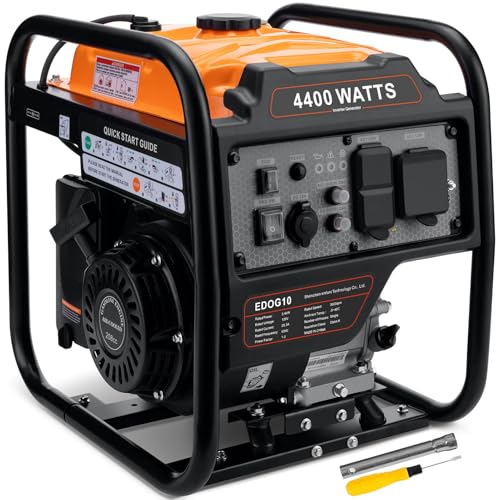
The Oxseryn 4400 is a lightweight inverter with 4400 peak and 3400 running watts, an ECO mode, and a 30-amp RV port, which fits a smaller cart running a fridge and a few small appliances. At about 56 lbs it is easy to move, and its inverter design keeps power clean for electronics.
Reasons to buy
- Powerful Output: 4400 peak watts and 3400 running watts, 2*120V AC ports, 1* 30A RV port,
- Gas Powered: 2 gallon fuel tank capital
- Features: Inverter technolog, ECO mode, EPA compliment, RV ready, overload protection, low
- Portable Generator: Weight 56lbs, lightweight and easy to move
- Note: All Oxseryn generators are functionally tested in the factory, so there may be a sli
Reasons to avoid
- 3400 running watts will not carry heavy cooking equipment like a griddle plus AC
- Gas-only with a 2-gallon tank means shorter run time between refills

PowerSmart 3600
The PowerSmart 3600 is the most portable option at roughly 50 lbs, with a 149cc engine producing 3600 surge and 3200 running watts and clean inverter power under 3 percent THD. It is parallel-ready, so you can link a second unit later if your power needs grow.
Reasons to buy
- 【MAXIMUM 3600W SURGE POWER】 Powered by a robust 149cc 4-stroke OHV engine, delivering 3600
- 【ADVANCED INVERTER TECHNOLOGY】 Produces clean, stable sine wave power (less than 3% THD) s
- 【EXTENDED RUNTIME & FUEL CAPACITY】 Equipped with a generous 1.3-gallon fuel tank, providin
- 【READY FOR DOUBLE POWER】 Features parallel connection capability (parallel kit sold separa
- 【PORTABLE & TOUGH DESIGN】 Despite its massive 3600W output, this unit maintains a manageab
Reasons to avoid
- 3200 running watts only suits a light cart, not a full galley
- The small 1.3-gallon tank needs frequent refueling during service
What to look for
Size to your full load
A food truck often runs refrigeration, cooking gear, lights, and a register at once, so choose running wattage that clears your combined continuous draw with margin.
Conventional vs inverter
Conventional units like the DuroStar and Westinghouse give the most watts per dollar, while inverter units like the PowerSmart models run quieter and cleaner for electronics.
Noise near the window
Engine noise reaches your customers, so quieter inverter designs or placing a loud open-frame unit farther away both help during service.
Fuel and run time
Dual-fuel units add propane flexibility, and a larger tank means fewer refuels during a long day, which matters when you cannot stop mid-service.
Weight and loading
You move this generator daily, so a 50-pound inverter is far easier to handle than a heavy open-frame unit, though it carries less power.
Our verdict
For most food trucks, the DuroStar DS13000MX is my top pick. It puts out 13,000 watts from a 500cc engine, runs on gasoline or propane, and is transfer-switch ready with a 50-amp outlet, so it can carry a fridge, griddle, and lights at once with headroom to spare.
FAQs
Add up your continuous loads like refrigeration, cooking equipment, lights, and your register, then pick a unit whose running wattage clears that total with margin. Heavy galleys lean toward the 13,000W DuroStar or Westinghouse, while light carts can use a 3,400 to 6,000W inverter.
Only if you run heavy cooking equipment that requires it. The DuroStar and Westinghouse offer transfer-switch-ready or 50-amp outlets for 240V, while the smaller inverters here focus on 120V loads.
Inverter units like the PowerSmart 7000 run quieter and produce cleaner power under 3 percent THD, which is safer for card readers and screens. The tradeoff is they usually cost more and offer less peak wattage than conventional open-frame units.
Dual-fuel units like the DuroStar and Westinghouse let you run gasoline or propane, which adds flexibility for storage and long service days. Gas-only units like the Oxseryn are simpler but tie you to one fuel.
The open-frame DuroStar and Westinghouse are noticeably loud and are best placed away from your service window. The PowerSmart 7000 lists around 70 dBA, and the smaller inverters run quieter, which helps in crowded spots.