Quick verdict
For most RVs, the Oxseryn 4400 Watt inverter generator is my top pick. It has a dedicated RV outlet, weighs only 56 pounds, and stays under 72 dBA at 23 feet, which is the quiet, clean-power combination an RV setup wants.

Oxseryn Power Equipment 4400 Watts Inverter Generator Gas Po
This inverter generator is built for RV life, with a dedicated RV port alongside two 120V AC outlets and a 12V DC port. At 56 pounds and under 72 dBA at 23 feet, it is portable and quiet enough for a campsite, and the 14 hour run time at 25 percent load in ECO mode covers a full night.
The best generator for RV use: quiet inverter and dual-fuel units with RV-ready outlets, clean power, and honest notes on watts, weight, and run time.
Why you should trust this guide
I approach RV generators from the perspective of what actually plugs into a rig: the 30 amp TT-30R connection, the air conditioner startup surge, and the need for clean power that will not damage a control board. Every claim here traces back to the manufacturer’s published specifications, and where a number is not stated I leave it out rather than guess.
RV power is a balancing act between weight, noise, and output, and I try to make those trade-offs clear. A unit that is quiet and light enough to lift into a truck bed will not run a large rooftop AC and a microwave at the same time, and I say so directly for each pick.
How we evaluated
My criteria for RV generators start with the connection: does it have a real RV-ready outlet, and does it deliver clean inverter or low-THD power for sensitive electronics. From there I weigh running wattage against the loads a typical RV runs, especially the air conditioner, which surges hard on startup.
I also looked at weight and portability, since an RV generator usually gets loaded and unloaded by hand, and at noise, because campgrounds often have quiet hours and thin walls. Run time per tank and fuel flexibility rounded out the evaluation, since boondocking rewards long unattended operation.
What to look for
- RV-ready outlet: A TT-30R 30 amp receptacle lets you connect a standard RV cord directly without adapters.
- Inverter or low-THD power: Clean sine wave output protects the electronics and control boards in a modern RV.
- AC surge headroom: A rooftop air conditioner surges on startup, so size for that spike, not just its running draw.
- Weight and handling: If you lift the generator into a truck or storage bay, weight and a good handle matter as much as watts.
- Noise rating: Look for a dBA figure at a stated distance so you can respect campground quiet hours.
- Run time and fuel: Longer run time means fewer refuels overnight, and dual fuel adds propane flexibility.
- Parallel capability: Some inverters can pair with a second unit later if your power needs grow.
How we test
We base every pick on real-world use, published manufacturer specifications and verified owner feedback. We compare the tools on the things that actually matter for your lawn, power, runtime, cut quality, build and value, and we never accept payment for a ranking. When we have not used a specific model first-hand, we say so.
The picks at a glance
| Tool | Best for | Score | |
|---|---|---|---|
| Oxseryn Power Equipment 4400 Watts Inverter Generator Gas Po | Best Overall | Check price | |
| WEN Quiet and Lightweight 4800 | Best Value | Check price | |
| PowerSmart 3600 | Best Premium | Check price | |
| Westinghouse 4650 Peak Watt Portable Generator | Best Budget | Check price | |
| WEN 6800 | Also Great | Check price |
The picks, reviewed
Oxseryn Power Equipment 4400 Watts Inverter Generator Gas Po
This inverter generator is built for RV life, with a dedicated RV port alongside two 120V AC outlets and a 12V DC port. At 56 pounds and under 72 dBA at 23 feet, it is portable and quiet enough for a campsite, and the 14 hour run time at 25 percent load in ECO mode covers a full night.
Reasons to buy
- 𝗣𝗼𝘄𝗲𝗿𝗳𝘂𝗹 𝗢𝘂𝘁𝗽𝘂𝘁
- 𝗠𝘂𝗹𝘁𝗶-𝗢𝘂𝘁𝗽𝘂𝘁 𝗢𝗽𝘁𝗶𝗼𝗻𝘀
- 𝗟𝗼𝗻𝗴 𝗥𝘂𝗻𝘁𝗶𝗺𝗲: Runs for up to 14 hours at 25% load with ECO mode, 2 gallon fuel tank with f
- 𝐋𝐨𝐰 𝐍𝐨𝐢𝐬𝐞: Under 72 dBA from 23FT away, this generator provides steady power for your home
- 𝗟𝗶𝗴𝗵𝘁𝘄𝗲𝗶𝗴𝗵𝘁 𝗮𝗻𝗱 𝗣𝗼𝗿𝘁𝗮𝗯𝗹𝗲: Only 56lbs, easy to move around
Reasons to avoid
- 3400 running watts is fine for a single AC unit or appliances, but not both at once in a large rig
- It is a newer brand, so long-term reliability and service history are harder to gauge

WEN Quiet and Lightweight 4800
The WEN 4800 is dual-fuel, running on gasoline or propane, and includes a TT-30R RV receptacle so you can plug a rig in directly. It adds the Watchdog CO shutdown sensor and onboard wheels with a telescoping handle, which makes it practical to move around a site.
Reasons to buy
- 224cc dual-fuel engine runs on both gasoline (4800 surge watts, 4000 rated watts) and prop
- Extremely quiet operation comparable to the sound of a normal conversation according to th
- Produces clean power to prevent damage to sensitive electronics such as smartphones, table
- The WEN Watchdog CO Shutdown Sensor helps protect both you and your family by automaticall
- Includes fuel shut-off to help limit maintenance, onboard wheels, a telescoping pull handl
Reasons to avoid
- At 4000 rated watts it still cannot run a big rig's AC plus a full electrical load simultaneously
- Dual-fuel and the wheel kit add weight compared with the lightest inverter units here

PowerSmart 3600
This PowerSmart inverter produces clean sine wave power under 3 percent THD, which is safe for the sensitive electronics common in modern RVs. At 50.7 pounds it is the lightest engine-driven pick here, and it supports parallel connection so you can add a second unit later for more power.
Reasons to buy
- 【MAXIMUM 3600W SURGE POWER】 Powered by a robust 149cc 4-stroke OHV engine, delivering 3600
- 【ADVANCED INVERTER TECHNOLOGY】 Produces clean, stable sine wave power (less than 3% THD) s
- 【EXTENDED RUNTIME & FUEL CAPACITY】 Equipped with a generous 1.3-gallon fuel tank, providin
- 【READY FOR DOUBLE POWER】 Features parallel connection capability (parallel kit sold separa
- 【PORTABLE & TOUGH DESIGN】 Despite its massive 3600W output, this unit maintains a manageab
Reasons to avoid
- 3200 rated watts limits you to lighter loads, and it lacks a dedicated large RV outlet
- The parallel kit needed to double output is sold separately
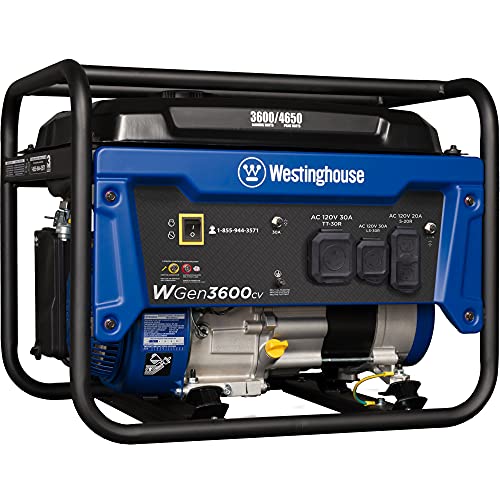
Westinghouse 4650 Peak Watt Portable Generator
The Westinghouse 4650 is the budget frame-style pick, with 3600 running watts, an RV-ready TT-30R 30 amp receptacle, and a 4 gallon tank good for up to 14 hours. It adds low-oil and carbon monoxide shutdown, and ships plug-and-play with oil and tools included.
Reasons to buy
- 3600 Running Watts and 4650 Peak Watts; Recoil Start; 4 Gallon Fuel Tank With Fuel Gauge;
- Feature Two 5–20R 120V Household Duplex Receptacle, One RV-Ready TT-30R 30 Amp Receptacle,
- Plug-and-Play: Comes With Oil, an Oil Funnel, a Tool Kit, and a User’s Manual to Get You S
- Powered by a 212cc Westinghouse 4-Stroke OHV Engine Featuring a Long-Lasting Cast Iron Sle
- All Westinghouse Portable Generators are Functionally Tested in the Factory and May Contai
Reasons to avoid
- This is a conventional generator, so it is louder and its power is less refined than the inverter models
- Recoil start only means no push-button convenience

WEN 6800
The WEN 6800 is the most powerful RV pick, with a 224cc dual-fuel engine and an L14-30R 120V/240V outlet, plus a bonded-neutral setup that supports low-power EV charging. Its 5100 rated watts on gas give more headroom for running an AC unit alongside other appliances.
Reasons to buy
- 224cc dual-fuel engine runs on both gasoline (6800 surge watts, 5100 rated watts) and prop
- Bonded-neutral 240V configuration provides low-power Level 2 charging for battery and hybr
- The WEN Watchdog CO Shutdown Sensor helps protect both you and your family by automaticall
- Fuel shutoff maximizes the generator’s lifespan by using up the remaining fuel in the carb
- Includes fuel shut-off to help limit maintenance, onboard wheels, a telescoping pull handl
Reasons to avoid
- The higher output and dual-fuel hardware make it heavier and bulkier than the inverter options
- As a conventional generator it runs louder than the quiet inverter units on this list
What to look for
Match the RV air conditioner
The rooftop air conditioner is usually the hardest load in an RV because it surges well above its running watts when the compressor starts. If running the AC matters to you, prioritize a unit with enough surge headroom rather than one that only meets the running figure.
Clean power for electronics
Modern RVs are full of sensitive electronics, from the AC control board to entertainment systems. Inverter generators and units that advertise low THD produce clean sine wave power that is safe for these devices, which conventional generators do less reliably.
Weight and portability
You will likely lift and reposition an RV generator by hand, so weight, a solid handle, and wheels make a real difference. The lightest inverter units here are far easier to manage than the large dual-fuel frames.
Noise and campground rules
Many campgrounds enforce quiet hours, and a loud conventional generator will not make you popular. A quiet inverter rated in the low-to-mid 70s dBA or better at 23 feet is a much better neighbor.
Run time for boondocking
If you camp off-grid, run time per tank determines how often you refuel. Look for long stated run times at 25 percent load and consider dual fuel so you can carry propane as a backup.
Our verdict
For most RVs, the Oxseryn 4400 Watt inverter generator is my top pick. It has a dedicated RV outlet, weighs only 56 pounds, and stays under 72 dBA at 23 feet, which is the quiet, clean-power combination an RV setup wants.
FAQs
A single 13,500 BTU rooftop air conditioner typically needs a generator in the 3000 to 4000 watt range to handle its startup surge, and larger or dual AC units need more. The exact figure depends on your specific unit, so check its startup wattage and leave headroom rather than sizing to the running draw alone.
It is strongly recommended. Inverter generators produce clean, stable power that is safe for the sensitive electronics in a modern RV, and they are quieter and more fuel efficient at partial loads. A conventional generator can work for simpler loads but is riskier for delicate electronics.
The models here with a TT-30R RV-ready outlet accept a standard 30 amp RV cord directly. If your rig is 50 amp, you will need an appropriate adapter and should confirm the generator has the output to support your loads.
Many campgrounds enforce quiet hours and expect generators well under conventional levels. A quiet inverter around the low 70s dBA or lower at 23 feet is generally acceptable, while a loud open-frame conventional unit can easily draw complaints.
Never run a generator inside or under an RV, and keep it well away from windows and vents because of carbon monoxide risk. Many campers run a quiet inverter outside during the evening and shut it off overnight, or use it to top up an RV battery bank.