Quick verdict
For whole-home backup, the Westinghouse 12500 Watt Dual Fuel is my top pick. It runs on gas or propane, is transfer-switch ready, and pushes 9500 running watts, which is enough to cover a well-appointed home during an outage.

Westinghouse 12500 Watt Dual Fuel Home Backup Portable Gener
This unit lists 9500 running and 12500 peak watts on gasoline, plus dual-fuel propane operation, so it can handle most household circuits at once. It is transfer switch ready with an L14-30R outlet, and the included remote start key fob makes it easy to bring online during an outage.
The best generator for home backup: dual-fuel and tri-fuel units with transfer-switch-ready outlets, real wattage, and honest sizing help for your home.
Why you should trust this guide
I research generators the way a homeowner shopping for backup power actually does: by reading the full manufacturer spec sheets, comparing running versus peak wattage, and looking closely at how each unit connects to a house. Everything I say about these models comes from their published specifications, not from marketing slogans. When a figure is not stated, I do not invent one.
My goal is to help you avoid the two most common mistakes with home backup: buying a unit too small to run what you need, and buying one so large it is impractical to store or fuel. I flag both failure modes for every pick, and I keep the focus on how the generator behaves during a real outage rather than on peak numbers alone.
How we evaluated
I evaluated these generators against the criteria that matter for home backup: running wattage as the true measure of what you can power continuously, fuel type and flexibility, and whether the unit is transfer switch ready so it can feed your panel safely. Peak or surge watts only matter for the brief moment an appliance starts, so I weight running watts more heavily.
I also considered run time per tank, safety features such as low-oil and carbon monoxide shutdown, and portability. A home backup unit that never moves can be big and heavy, but a unit you also want to take camping needs a very different profile. I make those trade-offs explicit so you can match the pick to your situation.
What to look for
- Running watts, not just peak: Add up the running wattage of everything you want on at once, then leave headroom for motor startup surges.
- Transfer switch readiness: An L14-30R or similar outlet lets a licensed electrician tie the generator into your panel instead of running extension cords.
- Dual or tri-fuel: Propane and natural gas store longer and stay cleaner than gasoline, which matters for outages that last days.
- Run time per tank: Longer run time means fewer refuels overnight and less fuel to store.
- Safety shutdowns: Automatic low-oil and carbon monoxide shutdown protect both the engine and your family.
- Weight and wheels: Large-frame home units are heavy, so confirm a wheel kit is included if you ever need to reposition it.
- Noise: If the generator will run near living space, check the dBA rating at a stated distance.
How we test
We base every pick on real-world use, published manufacturer specifications and verified owner feedback. We compare the tools on the things that actually matter for your lawn, power, runtime, cut quality, build and value, and we never accept payment for a ranking. When we have not used a specific model first-hand, we say so.
The picks at a glance
| Tool | Best for | Score | |
|---|---|---|---|
| Westinghouse 12500 Watt Dual Fuel Home Backup Portable Gener | Best Overall | Check price | |
| Oxseryn Power Equipment 4400 Watts Inverter Generator Gas Po | Best Value | Check price | |
| Westinghouse 14500 Peak Watt Tri | Best Premium | Check price | |
| Westinghouse 6500 Watt Dual Fuel Home Backup Portable Genera | Best Budget | Check price | |
| Westinghouse Outdoor Power Equipment 14500 Peak Watt Dual Fu | Also Great | Check price |
The picks, reviewed
Westinghouse 12500 Watt Dual Fuel Home Backup Portable Gener
This unit lists 9500 running and 12500 peak watts on gasoline, plus dual-fuel propane operation, so it can handle most household circuits at once. It is transfer switch ready with an L14-30R outlet, and the included remote start key fob makes it easy to bring online during an outage.
Reasons to buy
- 9500 Running Watts and 12500 Peak Watts (Gasoline); 8500 Running Watts, 11200 Peak Watts (
- Features Two GFCI 120V 5–20R 20A Standard Household Receptacle, One Transfer Switch Ready
- Powered by a Heavy Duty 457cc Westinghouse 4-Stroke OHV Engine Featuring a Long-Lasting Ca
- Plug-and-Play: Comes with a Remote Start Key Fob, 12V Battery Charger, Oil, an Oil Funnel,
- All Westinghouse Portable Generators are Functionally Tested in the Factory and May Contai
Reasons to avoid
- At 457cc and this wattage, it is a heavy, large-frame unit that is not easy to move without the wheel kit
- Gasoline run time tops out around 12 hours per tank, so long multi-day outages need fuel on hand

Oxseryn Power Equipment 4400 Watts Inverter Generator Gas Po
This inverter unit delivers 4400 peak and 3400 running watts, which is enough for a fridge, lights, and electronics rather than the whole house. It weighs only 56 pounds and lists under 72 dBA at 23 feet, so it is far more portable and quieter than the large-frame options here.
Reasons to buy
- 𝗣𝗼𝘄𝗲𝗿𝗳𝘂𝗹 𝗢𝘂𝘁𝗽𝘂𝘁
- 𝗠𝘂𝗹𝘁𝗶-𝗢𝘂𝘁𝗽𝘂𝘁 𝗢𝗽𝘁𝗶𝗼𝗻𝘀
- 𝗟𝗼𝗻𝗴 𝗥𝘂𝗻𝘁𝗶𝗺𝗲: Runs for up to 14 hours at 25% load with ECO mode, 2 gallon fuel tank with f
- 𝐋𝐨𝐰 𝐍𝐨𝐢𝐬𝐞: Under 72 dBA from 23FT away, this generator provides steady power for your home
- 𝗟𝗶𝗴𝗵𝘁𝘄𝗲𝗶𝗴𝗵𝘁 𝗮𝗻𝗱 𝗣𝗼𝗿𝘁𝗮𝗯𝗹𝗲: Only 56lbs, easy to move around
Reasons to avoid
- 3400 running watts will not cover central AC or a well pump plus everything else at the same time
- It is a lesser-known brand, so long-term parts and service support are harder to predict
Westinghouse 14500 Peak Watt Tri
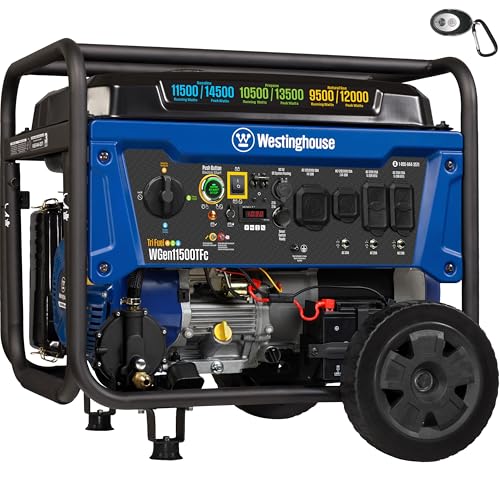
The tri-fuel design runs on gasoline, propane, or natural gas, which gives you the most fuel flexibility for a long outage. It lists 11,500 running watts on gas and up to 19 hours on its 9.5 gallon tank, and the low THD output is described as safe for sensitive electronics.
Reasons to buy
- Perfect as a backup power source for larger homes or a dependable source of portable power
- 14,500 peak watts, 11,500 running watts (gasoline); 13,500 peak watts, 10,500 running watt
- Powered by a heavy duty 550cc 4-Stroke OHV Westinghouse Engine constructed with a durable
- Engineered with low THD, so it's safe for sensitive electronics. Power phones, computers,
- All Westinghouse portable generators are gunctionally tested in the factory and may contai
Reasons to avoid
- The 550cc engine and large frame make this one of the heaviest options to store and move
- Natural gas hookup capability only helps if you already have a gas line and the right connection
Westinghouse 6500 Watt Dual Fuel Home Backup Portable Genera
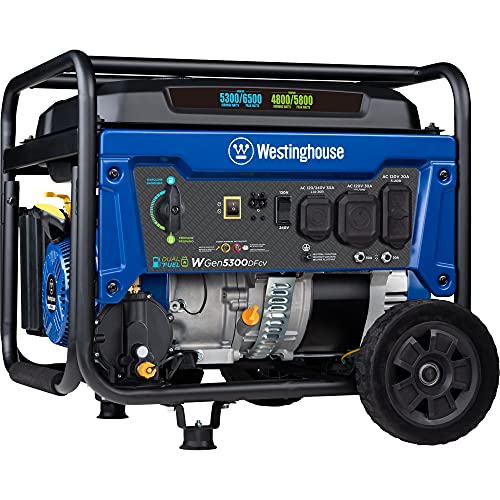
This is the budget dual-fuel pick at 5300 running and 6500 peak watts on gasoline, enough for a focused set of essentials. It is transfer switch ready with an L14-30R outlet and adds carbon monoxide auto-shutdown, which the larger 12500 model does not explicitly list.
Reasons to buy
- Gasoline: 5300 Running Watts & 6500 Peak Watts; Propane: 4800 Running Watts & 5800 Peak Wa
- Features One 5–20R 120V 20V Household Duplex Receptacle, One RV-Ready TT-30R 30A Receptacl
- Plug-and-Play: Comes with Oil, an Oil Funnel, Propane Hose, Tool Kit, Wheel Kit, and a Use
- Powered by a 274 CC Westinghouse 4-Stroke OHV Engine Featuring a Long-Lasting Cast Iron Sl
- All Westinghouse Portable Generators are Functionally Tested in the Factory and May Contai
Reasons to avoid
- 6500 peak watts limits how many large appliances you can run at once
- Recoil-oriented starting on a smaller frame means it is less plug-and-play than the remote-start models

Westinghouse Outdoor Power Equipment 14500 Peak Watt Dual Fu
This 14500 peak watt dual-fuel unit mirrors the tri-fuel model's gas and propane output and 19 hour run time, making it a strong alternative if you do not need natural gas. The 550cc engine and 9.5 gallon tank suit larger homes that want long unattended runs.
Reasons to buy
- Perfect as a backup power source for larger homes or a dependable source of portable power
- 14,500 peak watts, 11,500 running watts (gasoline); 13,500 peak watts, 10,500 running watt
- Runs for up to 19 hours on a 9.5 gal. fuel tank with built-in fuel gauge; up to 7 hours on
- Powered by a heavy duty 550cc 4-Stroke OHV Westinghouse Engine constructed with a durable
- All Westinghouse Portable Generators are Functionally Tested in the Factory and May Contai
Reasons to avoid
- Without natural gas capability it is slightly less flexible than the tri-fuel version for the same footprint
- The size and weight make it impractical for anyone who also wants a portable generator
What to look for
Size to your running load
List every appliance you must keep running during an outage, add their running watts, and add headroom for the surge when motors like a fridge or well pump start. Buy the smallest generator that comfortably covers that total, since oversizing wastes fuel.
Fuel flexibility for long outages
Gasoline is convenient but degrades and is hard to store in bulk. Dual-fuel and tri-fuel units let you switch to propane or natural gas, which store far longer and are useful when a multi-day outage empties local gas stations.
Transfer switch readiness
A transfer-switch-ready outlet lets an electrician connect the generator to your home panel so you can use existing wiring safely. Running everything through extension cords is both inconvenient and risky for hardwired appliances.
Run time and refueling
Larger tanks mean fewer overnight refuels. Check the stated run time at a realistic load, and remember that a bigger engine burns more fuel, so plan how much you can store safely.
Safety features
Automatic low-oil shutdown protects the engine, and carbon monoxide shutdown is an important safeguard because generators must always run outdoors and away from windows.
Our verdict
For whole-home backup, the Westinghouse 12500 Watt Dual Fuel is my top pick. It runs on gas or propane, is transfer-switch ready, and pushes 9500 running watts, which is enough to cover a well-appointed home during an outage.
FAQs
It depends on what you want running. A focused set of essentials such as a fridge, lights, and electronics can run on roughly 3000 to 5000 running watts. Covering central air, a well pump, and multiple large appliances at once pushes you toward 9000 running watts or more. Add up the running watts of your target loads and leave headroom for startup surges.
Dual fuel lets a generator run on gasoline or propane, and tri fuel adds natural gas. Propane and natural gas store much longer than gasoline and stay cleaner in the engine, which is a real advantage during long outages when gasoline is hard to find or store safely.
If you want to power hardwired items like a furnace or well pump, yes. A transfer switch, installed by a licensed electrician, safely connects a transfer-switch-ready generator to your home panel. Without one you are limited to plugging devices in with extension cords.
Never run a generator indoors, in a garage, or near open windows, even with the door open, because of carbon monoxide risk. Run it outdoors, well away from the house, and use a proper generator cover or tent rated for wet weather if you must operate it in rain.
A large-frame dual or tri-fuel unit covers more of the house but is heavy and stationary. A portable inverter is quieter, lighter, and cleaner for electronics, but it powers only essentials. Choose based on whether you want whole-home coverage or just the critical circuits.