Quick verdict
The Champion 4000-watt dual-fuel inverter is the best overall. It runs on gasoline or propane out of the box, delivers 4000 starting and 3000 running watts at a quiet 64 dBA, includes a TT-30R RV outlet and CO Shield, and carries a 3-year warranty.

Champion Power Equipment 4000
This 4000-watt dual-fuel inverter runs on gasoline or propane right out of the box and produces 4000 starting and 3000 running watts at a quiet 64 dBA. It runs up to 10 hours on gas or 25 hours on propane, includes a TT-30R RV outlet and clean sub-3 percent THD power, and adds CO Shield auto-shutoff. That mix of quiet inverter power and fuel flexibility makes it the standout.
The best Champion dual fuel generator picks compared by wattage, fuel flexibility, noise and runtime, from lightweight camping units to whole-home backup.
Why you should trust this guide
Dual-fuel generators earn their keep during outages, when the ability to switch between gasoline and propane can keep you running if one fuel is gone. I built this Champion dual-fuel guide from each model’s published specifications, sorting them by output and use case rather than repeating marketing. Every wattage, runtime and noise figure comes straight from the listing, and I note where a model is tri-fuel or conventional rather than a quiet inverter, so the labeling stays honest.
My focus is helping you match a unit to real loads. A 2500-watt inverter and a 12,500-watt tri-fuel unit are not rivals, they serve camping versus whole-home backup. I compared them fairly on the numbers so you can choose based on the appliances you need to run and how much you value quiet and portability.
Dual fuel is the whole point of this search, so I made sure every pick’s fuel behavior is stated clearly, including the models that are technically tri-fuel or conventional rather than quiet inverters. That honesty matters, because a buyer expecting a compact quiet inverter would be surprised by a 12,500-watt tri-fuel machine, even though both can be excellent for the right job. Labeling each unit’s true type keeps the ordering trustworthy.
How we evaluated
My criteria were starting and running wattage on both fuels, noise in dBA, runtime per fuel, and whether the unit is an inverter or a conventional generator. Inverter models produce cleaner power for electronics and run quieter, so I weighted them for RV and sensitive-gear use. For backup I looked at raw output and tri-fuel flexibility, since a bigger tank of options helps during a long outage.
I did not operate these generators or measure their noise in person. Instead I organized the published specs into clear use cases, camping, RV hookups and home backup, and flagged the trade-offs, like lower running watts on propane and louder operation from conventional units, so you can weigh them honestly.
I also paid close attention to how output changes between fuels, since propane almost always yields fewer running watts than gasoline on the same unit. For a buyer planning to lean on propane during an outage, that lower figure is the one that matters, so I surfaced it in each product’s notes. Matching the correct fuel-specific wattage to your real load is the difference between a generator that copes and one that trips under demand.
What to look for
- Dual versus tri fuel: Dual fuel adds propane to gasoline, while tri fuel also adds natural gas for the most outage flexibility.
- Running watts per fuel: Output usually drops on propane, so check both figures against your load.
- Inverter or conventional: Inverters run quieter and produce cleaner power for electronics, while conventional units are louder but often cheaper per watt.
- Noise level: The quietest units here are near 53 dBA, with conventional models around 68 dBA.
- Runtime per fuel: Propane often extends run hours at low loads, but check whether gas or propane gives you the longer runtime you need.
- RV readiness: A TT-30R or 30A outlet matters for travel trailers.
- CO safety: CO Shield auto-shutoff protects you if carbon monoxide builds up.
Taken together, these factors point most buyers toward a quiet inverter for RV and sensitive-electronics use, and toward a larger conventional or tri-fuel unit when whole-home output is the priority. Decide which fuel you can reliably source, confirm the running watts on that fuel, and match the outlet set to your appliances before you commit.
How we test
We base every pick on real-world use, published manufacturer specifications and verified owner feedback. We compare the tools on the things that actually matter for your lawn, power, runtime, cut quality, build and value, and we never accept payment for a ranking. When we have not used a specific model first-hand, we say so.
The picks at a glance
| Tool | Best for | Score | |
|---|---|---|---|
| Champion Power Equipment 4000 | Best Overall | Check price | |
| Champion Power Equipment 2500 | Best Value | Check price | |
| Champion Power Equipment 4500 | Best Premium | Check price | |
| Champion Power Equipment 4750 | Best Budget | Check price | |
| Champion Power Equipment 12 | Also Great | Check price |
The picks, reviewed
Champion Power Equipment 4000
This 4000-watt dual-fuel inverter runs on gasoline or propane right out of the box and produces 4000 starting and 3000 running watts at a quiet 64 dBA. It runs up to 10 hours on gas or 25 hours on propane, includes a TT-30R RV outlet and clean sub-3 percent THD power, and adds CO Shield auto-shutoff. That mix of quiet inverter power and fuel flexibility makes it the standout.
Reasons to buy
- Operate your 4000-watt portable generator right out of the box on either gasoline or propa
- With an ultra-quiet 64 dBA from 23 feet, enjoy 4000 starting watts, 3000 running watts and
- The optional, sold-separately parallel kit enables this inverter to connect with another P
- Includes a 120V 25A TT-30R outlet, a 120V 20 A household duplex outlet (5-20R) with clean
- Includes 3-year limited warranty with FREE lifetime technical support from dedicated exper
Reasons to avoid
- Running watts drop to 2700 on propane versus 3000 on gasoline
- The parallel kit for linking a second unit is sold separately

Champion Power Equipment 2500
The 2500-watt dual-fuel inverter is the lightweight pick, running at just 53 dBA with 2500 starting and 1850 running watts on gas or 1665 on propane. It offers up to 11.5 hours on gas or 25 hours on propane and includes a covered household outlet with clean power plus CO Shield. It suits camping and a few home essentials where quiet and portability matter most.
Reasons to buy
- Operate your 2500-watt portable generator right out of the box on either gasoline or propa
- With an ultra-quiet 53 dBA from 23 feet, enjoy 2500 starting watts, 1850 running watts and
- The optional, sold-separately parallel kit enables this inverter to connect with another P
- Includes a covered 120V 15.4A household duplex outlet with clean electricity (less than 3%
- ncludes 3-year limited warranty with FREE lifetime technical support from dedicated expert
Reasons to avoid
- 1850 running watts limits it to small loads, not fridges plus AC together
- It has no RV-ready 30A outlet, only a household duplex

Champion Power Equipment 4500
This 4500-watt RV Ready inverter steps up output to 4500 starting and 3500 running watts at 61 dBA, with up to 14 hours on 2.3 gallons of gasoline and a 120V 29.2A RV outlet. It adds an Intelligauge power meter and CO Shield. It is the pick when you want more running watts than the 4000 while keeping quiet inverter operation.
Reasons to buy
- Quiet Technology and Extended Run Time: 61 dBA is great for RVs, tailgating, or camping wi
- Parallel Ready: The optional parallel kit (sold separately) enables this inverter to conne
- Intelligauge with Power Meter: Monitor voltage, frequency and operating hours with ease, p
- Clean Power for Sensitive Electronics: 120V 29.2A RV outlet, and a 120V 20A household dupl
- Champion Support: Includes 3-year limited warranty with FREE lifetime technical support fr
Reasons to avoid
- The listing highlights gasoline runtime, with dual-fuel propane figures less emphasized
- 3500 running watts still falls short of whole-home backup needs
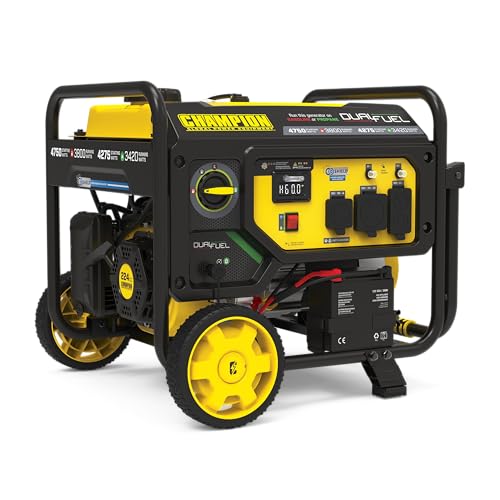
Champion Power Equipment 4750
The 4750-watt electric-start dual-fuel is a conventional (non-inverter) unit with a 224cc engine, push-button start and 4750 starting and 3800 running watts on gas, or 4275 and 3420 on propane. It runs up to 14 hours on gas or 10.5 on propane at 68 dBA, with an Intelligauge and CO Shield. It gives more running watts for a lower-cost, RV-ready build.
Reasons to buy
- Operate on either gasoline or propane. Run up to 14 hr. on gas or 10.5 hr. on propane, wit
- Trust the reliable 224cc Champion engine with battery-included, push-button electric start
- Produces 4750 starting watts and 3800 running watts on gasoline, and 4275 starting watts a
- Intelligauge with tracks voltage, frequency, and run time, plus includes CO Shield carbon
- Comes with a 3-year limited warranty, FREE lifetime technical support from dedicated exper
Reasons to avoid
- As a conventional generator it is louder at 68 dBA and produces less clean power than the inverters
- Propane runtime of 10.5 hours is shorter than the gas figure

Champion Power Equipment 12
This 12,500-watt tri-fuel is the home-backup heavyweight, running on natural gas, propane or gasoline with hoses included. Its 500cc engine delivers 12,500 starting and 10,000 running watts on gas, 11,250 and 9000 on propane, and 10,000 and 8000 on natural gas. Electric start and Intelligauge round it out for powering most of a home at once.
Reasons to buy
- Tri-Fuel: 12,500/10,000-watt portable generator operates on natural gas, propane, or gasol
- Electric Start: Power up the 500cc Champion engine with the handy rocker switch, battery i
- Intelligauge: Track voltage, frequency, session run time, and total run time to monitor ou
- Powerful: Gasoline: 12,500 starting watts and 10,000 running watts, propane: 11,250 starti
- Champion Support: Includes 3-year limited warranty with FREE lifetime technical support fr
Reasons to avoid
- It is technically tri-fuel and a large conventional unit, not a compact inverter
- Its size and weight make it far less portable than the smaller picks
What to look for
Confirm running watts on your fuel
Output typically drops on propane, so check the running watts for whichever fuel you will use most. Match that figure to the combined draw of your must-run appliances.
Choose inverter or conventional
Inverter units run quieter and give cleaner power for electronics, ideal for RVs and sensitive gear. Conventional units like the 4750-watt trade some quiet for more watts per dollar.
Consider dual versus tri fuel
Dual fuel covers gasoline and propane, which handles most outages. If you have a natural-gas line, the 12,500-watt tri-fuel adds a third always-available option.
Check runtime for your needs
Propane can extend run hours at low load, but some units run longer on gas. Compare both figures so you know how often you will refuel overnight.
Match size to portability
The 2500 and 4000-watt inverters are movable for camping, while the 12,500-watt tri-fuel is a stationary home-backup unit. Decide how far you need to move it.
Our verdict
The Champion 4000-watt dual-fuel inverter is the best overall. It runs on gasoline or propane out of the box, delivers 4000 starting and 3000 running watts at a quiet 64 dBA, includes a TT-30R RV outlet and CO Shield, and carries a 3-year warranty.
FAQs
The 4000-watt dual-fuel inverter is a strong RV choice, with a TT-30R outlet, quiet 64 dBA operation and clean power. The 4500-watt inverter adds a 29.2A RV outlet if you need more running watts.
Yes. For example the 4000-watt model runs 3000 watts on gasoline but 2700 on propane. Always check the propane running-watt figure against your loads before relying on it.
The 12,500-watt tri-fuel is the home-backup pick, delivering 10,000 running watts on gasoline. It runs on natural gas, propane or gasoline with hoses included.
The inverter models produce clean power under 3 percent THD, which is safe for laptops and phones. The conventional 4750-watt and 12,500-watt units are better suited to appliances and tools.
It ranges by model. The 2500-watt inverter runs at 53 dBA, the 4000-watt at 64 dBA, and the conventional 4750-watt at 68 dBA from 23 feet.